Words = 2561
Last edit 18h26 24oct09
A Tale of Two Dawns
Sitting alone on the western shore of Île Louise on the Kiamika Reservoir in the pre-dawn, I wait for the sun to come up. It is a special time of day for me and waiting for the dawn has been an integral part of my daily routine for much of my adult life. As an hyperactive person, the early morning is my quiet time to sit and reflect on the previous day and what has be done today. Watching the sun give new life to the day provides a spiritual moment in the life of an ADHD retiree. It becomes easy to understand how so many of the ancestors in different places around the world worshiped the sun as a god resurrecting life in the world. The class of anglo-Quebeckers, being teenagers, are still sound asleep, snug in their sleeping bags so I have the world to myself.
Across the bay in front of me is Le Grande Île de Perdrix with its Mount Royal sized hump blocking the sun from rising directly before me. Instead of a spectacular ball climbing into sight, I am treated to a slow glow over and around the mountain and the sky becomes gradually lighter. The period of mystical predawn is a very special time on Kiamika. Vapour mists lift from the lake and in colder corners whole clouds have settled into strategic bays. It’s cool in the autumn morning and the loon quivering call sends another shiver of excitement through my body. There is a light but stiff little breeze blowing on-shore, making the forest leaves and needles rustle, chilling the air and causing the waves to lap at my feet. On other days, I have waited on the shore for the sun to rise and been swallowed by the silence of a lake as still and smooth as glass and the quiet forest around me.
Kiamika was created, in part, to control the downstream flooding which results from the excess water released by the springtime thaws. It is a man-made reservoir created during the last gasp of the log drives so the draveurs would be able to stock the cut timber during the winter and in the spring drive the logs down the Lièvre River to the mills in the Ottawa Valley below. The reservoir serves 2 other purposes. First it controls the flooding in several rivers downstream including the Ottawa River. Because of a network of reservoirs far away to the north, the once perennial spring floods have more or less been eliminated on Île Jésus, Montreal’s sister island on which the City of Laval sits. The Kiamika also serves to hold back the water freed from the winter snow to make sure that the hydro generating plants, canals, irrigation projects and recreational boaters downstream will have the reserves they need to get through the driest summer. The real issue is an excess of water and controlling its flow to prevent destruction and improve productivity.
As I watch the sunrise, the smell of smoke on my clothes reminds me of the huge bonfire of the previous night fed by Céline, who calls herself the Fire Witch. She tells us her name with pride as she loads the bonfire with logs as big as her waist. Spruce, pine, birch and some maple logs lay as dead fall all over the little Île Louise and every spring the winter brings down more trees to be harvested for the campfires we enjoy on these crisp fall evenings. The island is uninhabited and covered by dense woods and underbrush so typical of the northern forests of Quebec. There is wood to burn for generations. The shores of the reservoir are also lined with tumbled heaps of beautiful, dry driftwood, sculpted and sanded into beautiful forms and figures fit for an art gallery but destined to be harvested for fuel and doomed to join the inferno of the bonfire.
As the flames leapt high into the night air, the 25 young students warmed themselves. The flames were so high and the heat so intense that they had to sit several feet away from the fire pit and sometimes stepped back into the fresh night air to cool off. The fire’s warmth lulled them into a comfortable glow and allowed them to open up into wonderful, warm revelations that could never occur in the noisy thump, thump atmosphere of an urban club where the kids would typically spend their Saturday nights. They were city slickers and had no idea how to use the fire to cook, apart from marshmallows and hot dogs on a stick. Still they were drawn to the flames and many of them spent the whole night chatting and basking in the warm security and comfort of the bonfire.
A short two months ago, I was shivering in the pre-dawn chill of an African July winter, sitting on the back porch of my sister-in-law’s house in Makupo Village, Malawi waiting and watch for the sunrise over the hills on the other side of the dambo behind our village. I was there guiding another group of Montreal college students and the early morning is my quiet time to plan the day and catch up with my journal writing. The first glow in the sky was very similar to what I saw over Île de Perdrix but the the rest of the scene was so very different.
Across the shallow valley called a dambo, the sun highlights a few trees along a horizon that stretches as far as the eye can see. The African high plateau is savanna country, not very different than the Canadian prairies in outline but totally different in content. The glow of the rising sun outlines in profile the women and girls walking through the fields from Mlangali and Chiwengu, the neighbouring villages carrying pails under their arm and making their way to the well. They walk up to a kilometer to get to the well, the nearest water to their homes. Their morning chatter brightens the soundscape with murmuring and laughter. The gathering around the village well grows and the rhythmic thump thump of the pump provides the bass to their gentle choir.
Smoke fills the air and makes the link to the camp on Île Louise. Again the comparison quickly ends there. Despite being rural, there are people all around and virtually everyone is up before dawn to get the day started. Fires for cooking breakfast and warming bathwater have been restarted by fanning into flames the coals left from the night before. No valuable matches or paper are used – that would be a waste. A cooking fire uses a pot sitting on 3 equally sized stones with 3 or fewer pieces of wood carefully burning under the pot. Just enough flame is nursed from the wood to cook the meal and after it has been prepared, the pieces of burning wood are withdrawn from the fire and extinguished, to be conserved for the next round of cooking. The wood is so judicially used that hot water for bathing can be heated at the same time as food is being cooked. The women can cook a four course meal on these little fires and deliver it steaming hot to the table.
These fires burning all over the country have led to very serious deforestation and soil depletion. In addition, more and more people are burning bricks to make permanent housing. The brick kilns are voracious and burn oxcarts full of logs. The few trees that remain from an earlier period of copious forests are very utilitarian – fruit trees for food, blue gums for construction, and the scrubby, or decorative shrubs planted around houses and as fences in dambo gardens. Even these survivor trees are at risk as the people, desperate for firewood, cut and burn almost anything in order to feed themselves and their families.
The people like to cook and heat with the gradually disappearing African hardwoods, because they burn slowly and intensely and create a long lasting coal which is good for cooking. Now they must pay a high price for the softwood pine scraps trucked hundreds of kilometers from the Vipya plateau to the north and sold in the local market. The pine burns with a quick hot flame, but turns very quickly from coal to ash and so much more wood must be used to cook the same meal. Even then, most villagers cannot afford to buy firewood in a country where many people never see a cash income, so the woman scrounge the fields and paths they walk along for ever smaller pieces of twigs and shrubs. The women collect these into waist sized bundles longer than they are tall and head-load them home with their babies on their back and carrying in their hands the tools they were using in the fields.
Even one year ago, bicycles passed by with firewood on the rear rack piled higher than the rider’s head on their way from Ngara Mountain, forty kilometers to the south. They could be flagged down in order to buy their loads for so little money that it could not adequately compensate them for the labour they had invested in their cargo. Now Ngara has been shorn almost bare and firewood is so scarce that people have resorted to cutting down the last productive trees on their postage stamp sized farm plots. With wood so scarce, each piece of fuel is used with care. For warmth in the cool July evening, people sit in tight knots squeezing as close as possible to the coals of the supper fire and then getting into their warm beds shortly after sunset. This also explains why they are also up and about as early as possible the next morning.
Water is life they say in Malawi. Even when it comes in the rainy season, so much water falls in one tropical rainfall that erosion is a serious problem. The rest of the time everyone worries about too little water. Lake Malawi, the tenth largest freshwater lake in the world fills the Rift Valley less than 100 kilometres from the village but it may as well be on another planet. Makupo sits on the high veldt more than a kilometre above the lakeshore and Malawi’s 14 million people would drain the lake very quickly if it were to be pumped and chanelled to every part of the country that needs water. During the rainy season, water is readily available, but when the life giving rains finish in April, the soggy mud that is the ground slowly dries into compact laterite as hard as concrete and the dry season forces dependence on well water.
The people of Makupo have traveled for years across the highway to the old mission to collect their water. Relatives in Canada recently raised the money to put a well in the middle of their village which changed the life of everyone there. The Makupo residents are the lucky ones and now the women of the nearby villages of Chiwayu and Mlangali trek to the new well and more than 250 people get the life sustaining water they need. They are all lucky because the Bwanali village 2 or 3 kilometres to the south must sustain almost 2000 people with one borehole. The women line up their pails in patient order and often wait 2 hours getting their chance at the pump. People are forced to use unsanitary groundwater or shallow hand-dug wells that disappear completely during the dry season.
Water and wood. In Canada, we seem to have a surplus of both and we hardly give a thought, let alone respect and care for them as essential resources. Clean water from a bore hole pump and a cheap plentiful supply of wood close to home would be a rural African woman’s dream.
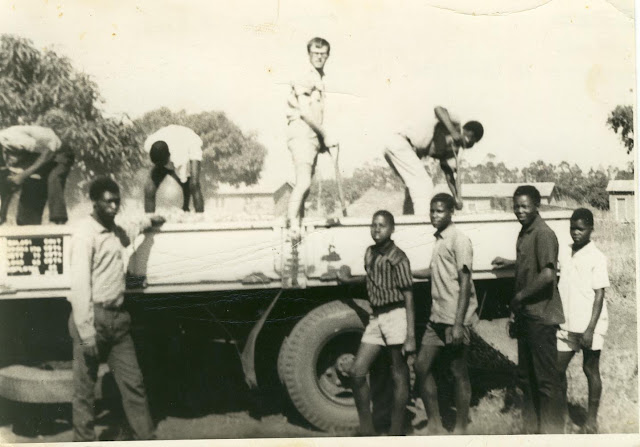
I have been intimately involved with Malawi, since 1968 when as a young teacher I arrived for the classic volunteer experience. In my rural Malawian secondary school, I watched as the women and children struggle with the old wheel style pumps that required a lot of effort to turn. The rural women had much better biceps than me from turning that wheel and chopping the evening meal with the basic axe they used. I admired how they were so economical with water and wood and how they worked so hard to carry the heavy bundles of wood and pail loads of water home on their heads. Even then, wood was becoming less available as more and more land was brought under cultivation to feed a growing population and to grow the tobacco, cotton, tea and groundnuts that earned the country’s meagre export income.
Whenever homesickness struck, I was never nostalgic for the fast food and flimsy attractions of city life. I dreamed of my boyhood at the cottage near Lively and my boy scout canoe trips on the water paddling through the Canadian northlands and sitting around blazing campfires. The Laurentian shield and its endless forests and lakes and rural the villages of Malawi always seemed so distant and disconnected. The expensive and extensive systems set up to harness the surplus in Canada stood in stark contrast to the struggle to satisfy the basic daily needs in Africa.
Over the years, governments have come and gone, international experts have ridden their development models into Africa and then ridden off into the sunset while the life of the rural women remains very much the same struggle to find clean water and enough wood to cook a meal for her family. My marriage to a Makupo maiden almost 40 years ago connected me to their condition beyond the normal 2 year volunteer commitment. Nellie and I have traveled down many paths together and now our four children and their kids are all comfortably settled in Montreal. But our concern for the sisters, nieces, and the whole over-extended family living the dilemma has only grown as their perennial struggle for the basics of life and dignity never seems to abate.
I have retired from my work as a college educator and come along as an instructor on the outdoor education courses in northern Quebec to earn some extra money to supplement my pension. With that money and what we recruit from friends and from a variety of fundraising schemes, we are trying to set up small enterprises, restore the environment and end the dependence of the people of Makupo. We have learned from the large scale development schemes that have generally left the rural people impoverished. We are modestly aiming very small ̶ just Makupo and its close vicinity. The well was a first step, planting African hardwoods around the village territory is another. A small piggery will provide a steady income for the village women and other ideas are in the works. The villagers have never dreamt large when life has been so circumscribed by the constant struggle. They know the situation is desperate and are eager to regenerate the soil, reforest the land they can influence.
Still in the morning quiet, I dream of how to bring a Canadian lake and forest to Makupo or of resettling African villagers on Île Louise so they never have to want for water and fuel again. Life should be that simple…
Friday, March 19, 2010

Subscribe to:
Posts (Atom)