Building Mitundu: Building Doug
Mitundu Day Secondary School
Anytime between 1969 and 1971
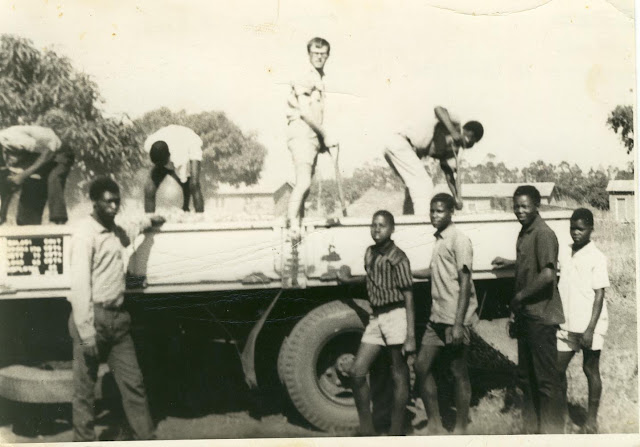
Many people help shape our lives. In my case it was a place, Mitundu Day Secondary School and the people I lived there with for 3 years. The picture shows a young man, not much older than his students and certainly not as worldly wise. He was learning more about life in 3 years at Mitundu than he did in 3 years at Carleton University getting his Bachelor degree. It was an experience that grounded an idealistic young man intent on contributing to nation building and who found his life course changed irrevocably as a result.
We were shovelling sand off the back of a flat bed truck, lent for the day to the the school by Mr Chapotera, a local business man. We were doing our part as self-help to build the school.
The secondary school site was nothing exotic to write travel books about. Dusty in the dry season, muddy in the rainy. Green and lush when the rain came, but brown and drab when the land dried up. A rough road ran by on its way to Mitundu trading centre and a side road ran over to Bunda College of Agriculture. Bunda was a growing college and was a great resource to have so near by. There was a busy market on Saturdays at Mitundu and it was a weekly ritual to pedal out there for supplies. During the rainy season, the road could become well nigh impassible. The area is part of Malawi's central plains with Bunda mountain dominating the local geography. These inselbergs, dot the highlands and offer majestic views. There was a forest reserve nearby that was a nice walk on hot days, but really there was nothing much to attract people to the area's otherwise flat fields and scrubby, plain, bush geography.
At first, we took over an existing primary school at the trading centre. It was a well constructed brick building with a high tile roof, but it necessitated a five mile drive twice a day over a terrible dirt road. The future campus was at the junction where the road to Bunda branched off, but nothing had been built when the first students were assigned to the school. The government was committed to putting schools in every district as part of the post-independence expansion of the educational system to make up for the century of colonial neglect. As we travelled back and forth 2 or 3 times a day from Bunda to Mitundu trading centre, they built the office block, the first 3 classrooms and the teachers' houses. We built much of the rest through self-help.
Housing for the students was always a problem. Since it was nominally a 'day' school the students were supposed to live within walking distance, but that was not the reality. They came from many distant places and at first were housed in old stores at the trading centre or paid room and board to local villagers with a spare room to offer. These were often decrepit, old storerooms and leaky sheds. The first 2 classes of Form One really had a difficult time of it. When the the new classrooms at the school site near Bunda were ready in January 1969 the first group had to move there and find the same kind of inadequate rooms among the local villages. The new group of Form Ones arrived to take up quarters in the Mitundu trading centre.
The students couldn't study in such adverse conditions so we organised study hall for 2 hours every night so they could access the classrooms, and study with proper lighting. We kept this tradition going even after we had hostels and more favourable conditions and there is no question this disciplined extra study was a contributing factor that led to so many of our students succeeding in their Junior Certificate exams.
Kennedy Msonda, the headmaster was dynamic, hard working and determined. He had spent a year in the USA and come back with a Yankee get-the-job-done mentality. He was going to build a school and was not about to let bureaucratic rules or lack of funds stand in the way. Most people were swept up in his energy and enthusiasm. In addition to managing the building of the school through government resources, he organised the self-help building of hostels for the girls and then the boys, added an extra classroom, put in a football field and a basketball court. When he could not get a truck from any ministry or government office, he would get Mr Chapotera, Mnjolo-Mkwinda or the Bunda principal to contribute. Mr Chapotera also helped us transport the school football and netball teams to other schools for competitions.
Kennedy recognised that his students came from other places and as such the government was not fulfilling its promise for the day schools to serve the needs of the students of the local community who thirsted for education. To serve the local demand for education, he set up night school which actually started at 4:00 in the afternoon as an outreach of the old Malawi Correspondence College. The classes were not limited in size and were huge compared to the day classes. The teachers would work with the day students from 7:30 a.m. to 1:30 p.m. when they got their lunch break and then return to teach the two classes of night school until 6:00 p.m. Working 2 shifts like this meant a lot of preparation and marking and long days. I was so tired that I would often fall asleep in the early evening as I was correcting assignments. To stay ahead, I learned to get up very early in the morning and get as much of my work done while I was still fresh. This has become a life-long habit, that carried me through my own studies for my masters degree.
Often Kennedy's drive to build the school made him push the students and staff really hard. I was single and nominally a volunteer who had signed up for just such an experience. On the other hand, the students found it hard to have to go to class in the morning and then be asked to shovel sand or carry loads of bricks to move the many projects forward. Teachers were paid to teach and did not always share his enthusiasm and belief in these extra-curricular self-help activities.
To keep some balance in their lives there would be events every weekend. He was passionate about football and the girls played netball. Some of the students were talented drummers and dancers and would perform traditional dances including the famous gule wamkulu. I had purchased some penny whistles that I lacked the talent to play, but again some of the boys could really make them swing. The dances were fun and the girls and the boys enjoyed trying to teach the Canadian how to dance and keep the most basic beat on the drum. Kennedy would borrow a slide projector from Bunda and show some of his slides from the USA and the few I had taken by that time.
One might think that it would have been tempting to escape to the more exotic mountainous or lake areas and I certainly did take the occasional holiday like that. But on the whole, I was so happy with my assignment and the social life around me that I spent most of my weekends for many months living and learning and exploring my rural environment. I was known as the hermit by the other Canadians I had come with to Malawi in July of 1968, because they saw so little of me. Once I had a bike, I would travel with Mr Ndjovuyalema all over the countryside and learn about the world of peasant farmers.
At Bunda College there were equal numbers of recent Malawian graduates and expatriates. I came to be good friends with several of the Malawi guys who enjoyed going to town with me for parties and other outings to the lake. Some like Alan Mtegha and Timothy Ngwira remained life long friends. Among the expatriates, I am still in touch with Mrs Betty Black, Frank Hannah and Margaret Gunn now Ngwira who is a naturalised Malawian. The presence of expatriates at Bunda meant I could usually get a lift to town, but because of my involvement with the school, I had little motive to leave.
Besides Kennedy, my other friends at Mitundu were extremely influential in shaping who I would become and teach me important lessons about life. Joe Kumbuyo was the school clerk. He was always friendly and informative. He had a slightly cynical eye that tempered my enthusiasm and naivety. Over the 3 years I spent there we became very close. Eventually when I was getting married, he acted as my family nkhoswe and helped me follow the Chewa customs and do things the proper way. He later married Hilda Namponya one of the beautiful girls I taught. Much later in 1996, he and Hilda hosted me for a month at Bunda where he had become an administrative officer. I got to know his family and their daughter Siyelini, in particular helped me in the research I was doing for my Master's degree.
Nellie Saka arrived in January 1969 with Betty Kaunda and Agatha Jalale as the new teachers to deal with the expanding student population. They were a wonderful addition and certainly added greatly to the social dynamic of our little community. Needless to say, the local bachelor population was glad to have three eligible and attractive women to talk with. The story of Nellie and I is another chapter to be written later. However, as we fell in love, I had less and less reason to leave the school and until the end of 1969 when she was unceremoniously transferred to Chichiri Secondary School, I was an extremely happy young man.
Mr Ndjovuyalema was a friend of Joe's, a peasant farmer and friend. He enjoyed interacting with the friendly mzungu and on weekends would take me for long bike rides through the countryside. He had an old bike held together by bits and pieces like many rural bikes. His heel served as a brake applied to the rear wheel. The roads only serve people with the means to take cars,trucks or buses. Out of sight, the countryside is a myriad spider-web of footpaths which serve the many people who rarely needed a road. These led to just about anywhere and places inaccessible to road traffic. We pedaled these paths to Mitundu, Mlale mission which had a couple of French-Canadian missionaries, to Malingunde dam where the expatriates sailed their boats on the weekends and even to Likuni Mission. Every little group of houses we would have to stop to greet someone he knew who was related to someone in another spider web of relationships. He introduced me to 2 of his wives and I learned about agriculture, dambo farming, and life in a small village. He and I met again in 1996 and he once again rode with me around the area and re-introduced me to its people.
Of course, the students were what the experience was all about. So many came from difficult circumstances and school was their chance to escape the life circumstances imposed by poverty. They were without exception hard-working, intelligent, wonderful humans, each with qualities that I admired. A number were older than me or at least the same age. Too many names have escaped my memory, but the faces, and their eagerness to learn remain indelibly etched. They struggled with English and turned it into a game to make it fun. “Sir, why do we say, 'I hope this rain keeps up.' when it is coming down?” The girls would often struggle hard to keep up and the arrival of the 3 women teachers made it much easier for them to see female role models who could inspire them to greater effort. The football and netball teams that Msonda nurtured were a source of great pride as we competed and won against students from fancier schools. The first group of students to write their Junior Certificate exams succeeded far beyond our expectations and Mitundu set a record for the new day schools of its kind with the number of form 2 graduates selected to continue on to form 3 in other schools around the country.
As I visit the country in my new role, I keep bumping into Mitundu alumni from that pioneer era. In January 2008, the group village headwoman for Bwanali, the village neighbouring Makupo came to visit after church and introduce herself as Alice Chingwede one of the students from the first group at Mitundu. She had become a prinary school teacher and taught for a number of years in the Mchinji area and now had returned to her home village and been elected as a group village headwoman. On a visit to Bunda College as part of this latest research with Christopher Stonebanks, we noticed a gentleman locking his office door to leave for lunch. He is Dr Stanley Khaila with his PhD in rural Sociology a lecturer at Bunda College and doing research with rural populations. He was also in one of the first groups. He was extremely welcoming and cordial and showed great interest in the rural research I am exploring now with Christopher Stonebanks. He also gave me the coordinates for Dr Sosten Chiota also from the second group to enter Mitundu. Sosten invited me to supper in Zomba when I passed through. It was a great evening of catching up and sharing. He is the one who provided me with the old picture of me on the truck. What a wealth of memories that photo unleashed. The students and staff worked extremely hard to build that school and became really close in the process.
Other people also were part of my post-adolscent growth and learning. The local chief, Mnjolo Mkwinda, also contributed to the building of the school with his transport and political support. The sound of the gule drums from his area on the bright moonlit winter nights was enchanting and mysterious. He was an industrious and prosperous man and he honoured me on my wedding day by attending with his youngest wife and representing me as part of his area. This greatly impressed and reassured Nellie's family that the boy their daughter was marrying was a credible person in the world he lived.
When I next saw the school in the mid 1970s it had undergone considerable expansion as part of an USAID programme to build infrastructure in eduation and health. The next time I saw the school was in 1996 and 20 years of neglect. After the short burst of investment in infrastructure, the international donors changed their philosophy with the election of Regan and Thatcher and all support for government infrastructure disappeared as support for free market private entreprise replaced planned and organised development plans. The government lacked the funds to maintain the infrastructure and the lovely edifices of the 1970s that represented such hope and possibility slowly decomposed with use, abuse and neglect.
Sosten and others from his generation have already begun meeting as alumni and were trying to track down their former teachers when I ran into Stanley at Bunda. Their goal is to try to rehabilitate the school and re-establish a bit of that sense of pride that we once had when we accomplished so much with so little. They have already begun re-establishing contact with many long lost classmates. Among the teacher alumni Kennedy, Joe and Mr Gausi are no longer with us. We can try to track down Betty Kaunda and Agatha Jalale in Malawi. Among the expatriate teachers, I know where Lorne MacLeod lives and will try to find David Scarborough and Carol Gabbert. David, a Peace Corps replaced Nellie when she left Mitundu and we taught together for a year and a half. Carol followed me as a CUSO and inherited my dog chiwewe. Lorne was there from 1974 to 1977 when CUSO withdrew from Malawi.
Reconnecting with everyone, sharing photos and memories would be a very useful thing at this stage in my life. Since retirement, I have become re-involved with my Malawi life and a 40 year old commitment to help bring change is burning anew. Re-examining the roots of this love of Malawi is very much part of a review of a life-time of involvement and trying to understand where I have been and what I have done. That experience has shaped me into what I am today. It may be a rather funny shape with age and baldness, but it's a good shape and Mitundu is certainly an important part of it.
Friday, June 12, 2009

Sunday, June 7, 2009
Indigenous Knowledge
Indigenous Knowledge
5 June 2009
Christopher Stonebanks introduced me to Royal Orr who has been supporting the work of an association of nurses in southern Tanzania, called Highlands of Hope and which focuses on HIV/AIDS.
Christopher was finishing his PhD in 2002 when Jock, Guy and I recruited him for a research project we were working on at Vanier College. We required someone who was strong on qualitative research with a background in ethnography. Since then, he has become a tenure track professor in the Education Faculty of Bishops University. He is also on the Board of Governors of the Paulo and Nina Friere project for Critical Pedagogy at McGill University and has written and published on multiculturalism, Islam, critical pedagogy and qualitative methodology.
Royal Orr is on the Board of Bishop's university and Christopher wanted us to meet so we could look at areas of collaboration. That led to Christopher and I hatching a plot to go to Tanzania together to visit Highlands of Hope and then tour Malawi in order to develop a research grant proposal on the theme of indigenous knowledge. That is how, even though I have no idea what I am talking about, I am travelling the country with a university professor and a Cree student meeting with people and looking at the resources that exist.
IK is an initiative to integrate into school curriculum the knowledge of the people that in many cases is not represented or present when one looks through the content of many school syllabi. The Cree and other native people of North America have lived with this for centuries with the residential schools being a blatant attempt to stamp out their traditional ways and assimilate them into the majority culture. The schools their children now go to have 90% drop out rates because the material covered does not reflect the reality they live and is still strongly assimilationist.
The school system here in Malawi has followed a similar pattern. Schools were first introduced to Malawi as part of the missionary project to stamp out the pre-Christian religions and create African replicas of the colonial British. The current system has largely been solidified into the pattern implanted by the British – a system that has long ago been discarded in the places where they originated.
On the whole, young people walk out of their village environment into school and begin to acquire knowledge that comes from elsewhere and does not reflect the reality of their homes or situations. To further complicate the student's learning they must move out of their mother tongue and start English in standard (grade) 3 and by standard 8 they must write and learn everything in English. The schools train students to leave their environment and communities and not to return to them with the ability to contribute, build and develop them.
Here in Malawi there does not seem to be any debate around the idea of seeking out indigenous education and ways of knowledge and building curriculum which includes it as an equal and valued part. We learned from the Principal of the Kasungu Teacher Training College that a number of courses have been created since independence which deal with life skills and social science elements of everyday reality. But on the whole, there do not seem to be any initiatives or impetus to reshape or re-frame the curriculum to build on and work out from local knowledge, wisdom and reality.
From the Canadian perspective we have much to do. In Quebec there has been much resistance to the introduction of competence based education which has as its goal to give classroom teachers much more flexibility to design curriculum appropriate to the local conditions. Old paradigms die hard. Teachers and other educators who were raised in one model and succeeded therein will naturally emulate it, since it worked for them. This goes on despite the evidence that the current system does not serve the majority of its students. There are many different learning styles and the traditional magisterial model appeals only to a few learners.
Switching from content based learning to process based learning requires considerable effort. Learning how to learn seems to be a more ill-defined and indefinite goal, than memorising a few lines and repeating them accurately but with little idea of the why and wherefore we had to learn them. Even students will resist if the change requires them to work a bit harder to acquire knowledge.
At first I didn't think, I wold be able to contribute much to Christopher's quest, but, in fact, my own background in educational research, working with underachieving students and experiential education as well as my experience teaching in Malawi right after independence have all been based on making learning relevant to learners and putting the labels of critical pedagogy or indigenous knowledge on my work comes rather easily. And, true to form, I get involved in something, do it, and then later go back to pick up the theory.
We are here in Blantyre for 2 nights before we start our trip north to Tanzania. We will do it in stages with stops in Nkhata Bay and Karonga along the way. In Zomba we met the Dean of the Education faculty of Chancellor College as well as the Director of the Centre for Social Research.
We also met a former student, Dr. Sosten Chiota from my first years of teaching at Mitundu Day Secondary School in 1968 to 1971. He and some alumni from the same era want to do something to rejuvenate the school which has fallen into a sad state. I will write that up when I get at the computer next time.
5 June 2009
Christopher Stonebanks introduced me to Royal Orr who has been supporting the work of an association of nurses in southern Tanzania, called Highlands of Hope and which focuses on HIV/AIDS.
Christopher was finishing his PhD in 2002 when Jock, Guy and I recruited him for a research project we were working on at Vanier College. We required someone who was strong on qualitative research with a background in ethnography. Since then, he has become a tenure track professor in the Education Faculty of Bishops University. He is also on the Board of Governors of the Paulo and Nina Friere project for Critical Pedagogy at McGill University and has written and published on multiculturalism, Islam, critical pedagogy and qualitative methodology.
Royal Orr is on the Board of Bishop's university and Christopher wanted us to meet so we could look at areas of collaboration. That led to Christopher and I hatching a plot to go to Tanzania together to visit Highlands of Hope and then tour Malawi in order to develop a research grant proposal on the theme of indigenous knowledge. That is how, even though I have no idea what I am talking about, I am travelling the country with a university professor and a Cree student meeting with people and looking at the resources that exist.
IK is an initiative to integrate into school curriculum the knowledge of the people that in many cases is not represented or present when one looks through the content of many school syllabi. The Cree and other native people of North America have lived with this for centuries with the residential schools being a blatant attempt to stamp out their traditional ways and assimilate them into the majority culture. The schools their children now go to have 90% drop out rates because the material covered does not reflect the reality they live and is still strongly assimilationist.
The school system here in Malawi has followed a similar pattern. Schools were first introduced to Malawi as part of the missionary project to stamp out the pre-Christian religions and create African replicas of the colonial British. The current system has largely been solidified into the pattern implanted by the British – a system that has long ago been discarded in the places where they originated.
On the whole, young people walk out of their village environment into school and begin to acquire knowledge that comes from elsewhere and does not reflect the reality of their homes or situations. To further complicate the student's learning they must move out of their mother tongue and start English in standard (grade) 3 and by standard 8 they must write and learn everything in English. The schools train students to leave their environment and communities and not to return to them with the ability to contribute, build and develop them.
Here in Malawi there does not seem to be any debate around the idea of seeking out indigenous education and ways of knowledge and building curriculum which includes it as an equal and valued part. We learned from the Principal of the Kasungu Teacher Training College that a number of courses have been created since independence which deal with life skills and social science elements of everyday reality. But on the whole, there do not seem to be any initiatives or impetus to reshape or re-frame the curriculum to build on and work out from local knowledge, wisdom and reality.
From the Canadian perspective we have much to do. In Quebec there has been much resistance to the introduction of competence based education which has as its goal to give classroom teachers much more flexibility to design curriculum appropriate to the local conditions. Old paradigms die hard. Teachers and other educators who were raised in one model and succeeded therein will naturally emulate it, since it worked for them. This goes on despite the evidence that the current system does not serve the majority of its students. There are many different learning styles and the traditional magisterial model appeals only to a few learners.
Switching from content based learning to process based learning requires considerable effort. Learning how to learn seems to be a more ill-defined and indefinite goal, than memorising a few lines and repeating them accurately but with little idea of the why and wherefore we had to learn them. Even students will resist if the change requires them to work a bit harder to acquire knowledge.
At first I didn't think, I wold be able to contribute much to Christopher's quest, but, in fact, my own background in educational research, working with underachieving students and experiential education as well as my experience teaching in Malawi right after independence have all been based on making learning relevant to learners and putting the labels of critical pedagogy or indigenous knowledge on my work comes rather easily. And, true to form, I get involved in something, do it, and then later go back to pick up the theory.
We are here in Blantyre for 2 nights before we start our trip north to Tanzania. We will do it in stages with stops in Nkhata Bay and Karonga along the way. In Zomba we met the Dean of the Education faculty of Chancellor College as well as the Director of the Centre for Social Research.
We also met a former student, Dr. Sosten Chiota from my first years of teaching at Mitundu Day Secondary School in 1968 to 1971. He and some alumni from the same era want to do something to rejuvenate the school which has fallen into a sad state. I will write that up when I get at the computer next time.
Tuesday, June 2, 2009
South Africa 14 or 18 years later
I apologise for the late arrival of this piece.
I wrote it while staying in Capetown with Terna and Koni last March 2008 and only just now got around to publishing it. The recent election doesn't change much of my view of things. I look forward to another visit next year for the World Cup of Soccer.
Blog 9 South Africa 14 or 18 years later
Eighteen years ago Nelson Mandela walked out of prison.
Fourteen years ago the historic post-apartheid elections took place and overshadowed Malawi’s equally important transition to democracy.
For me, a trip to South Africa is very special and the chance to go to Capetown and visit some old comrades and friends and just see that very beautiful part of the world is a real privilege. Before leaving Canada, one hears about the problems and mostly the violence in South Africa. The statistics reveal more homicides and rape per inhabitant than anywhere else in the world that is not caught up in a war zone. Eight of ten women will be raped as a matter of course; there are huge numbers of homeless and squatters; there is also enormous disparity and of course there is the whole AIDS denial issue and refusing to deal with the issue head on. Was I excited or afraid? Fear seems to be the theme and pictures of walled compounds and electrical razor wire confirm that it must be true.
The opportunity arose because I was going to Malawi to be with another group of visitors to Makupo. This time it is Smokey Thomas, president of the Ontario Public Service Union (OPSEU), his wife Val and 2 boys, Jesse 14 and Scottie the youngest, who is 11. Also traveling is Smokey’s executive assistant, Ron Lavigne and his 18 year old son, Zack, who is training as an electrician. The trip is being organized by our old comrade Brenda Wall who looks after the OPSEU Social Justice Fund. They are visiting projects that the union has already funded and are scouting out new initiatives. Their trip started in Capetown and so I took advantage of the reduced fare on the distance between Lilongwe and Capetown to visit the phenomenon that is modern South Africa in all its beauty and complexity.
My hosts are a fascinating example of the new SA. There is four year old Sankara named after the Burkinabe revolutionary and he warrants the name. He is a wonderful mix of Africa’s different sides. Mom is Koni Benson, born in Canada of South African parents who left the country to avoid having to raise a family under apartheid racism. Dad is Terna Gyuse whose Nigerian parents were students at the time he was born. Terna introduced me to radio and has been a constant beacon in terms of political analysis since 1996. Koni is a historian and committed feminist. They decided to try settling in Capetown and have become deeply immersed in the life of the people still struggling for a place in that complicated society. Koni works for ILRIG the International Labour Rights and Information Group where she has a special focus on women’s issues and the informal settlements or squatters. Terna is working for Free Speech International and is their representative in South Africa, although his mandate is world wide.
The issue of fear is always there. South Africa has a history of violence. It has grown that way from the times of Shaka to the barbarity that was the Boer War, to the implementation of the systemic violence that is apartheid. A walk through Observatory, one of the nearest (white) suburbs to downtown and the walls and wire are imposing. Security is the growth industry. The transition of crossing one street, and a short walk into (coloured) Salt River finds lower walls, no wire and matrons leaning on the porch. Over the walls of Obs hang a profusion of plants and flowering trees in the front yards. There are few cars on the street since most of them are nestled inside the protection of the walls and electrical razor wire. The streets of Salt River are jammed with parked cars since there are almost no front yards. The matrons on their front porches are leaning over the sidewalk to see who is coming – the most effective security system. Young men and old sit on the sidewalk here and there out of the sun and out of the house chased there by the matrons who won’t let them smoke inside.
Even fear is a hold over from the apartheid – whites are afraid – of what – of redistribution and sharing. Under apartheid, the walls were around whole cities and separated people by colour. A black person in the city centre after dark was arrested or worse, so the freedom enjoyed by whites seemed greater but was still very much circumscribed by the walls of laws and a police state. Democracy and integration means that the laws of racial separation are gone and class walls are built that must respect the rules of a multicultural society. It’s much harder to know who you are walling out when the visual signal of skin colour is no longer the simple criteria. Johannesburg city centre is now inhabited by a lumpen-proletariat that is largely black and from all over Africa, scrambling to make a living in a very competitive and often violent environment. The richer classes no longer have a place there. Drive a fancy car, regardless of colour and you run the risk of problems – Lucky Dube the reggae musician was gunned down in a carjacking and his murderers probably knew who he was, but the class struggle is so sharply alive, that even a man of the people like him was not immune from what can happen.
Sadly, the party in power has turned its back on the people, at a very fundamental level. The ruling classes have enriched themselves with vigour and the discredited business model is touted as the route to development while the statistics point to ever increasing disparity as a result of inequitable access to the economic means, resources, jobs, housing, education, etc… to live even decent lives. The shanty-towns, squatter settlements and the Bantustan backwaters remain outside the development sphere.
Even more troubling are the many really good people who have remained part of the structure to try and change the system from within and they do some very good work, building houses and providing clean accessible water. They moved into power with the transition from liberation movement into a political party and government. Sadly, they are no longer representing the working classes and other marginalized people. The organs of resistance like the trade unions and SACP have found much of their senior leadership co-opted into positions of ruling and whether intentional or not they have become part of the structure of underdevelopment. Instead of militating and pressuring government to follow a pro-people course, the wonderful old comrades are now administering a capitalist state and contributing to the building of a new class society which will inevitably be confronted with the demands of the people who are being left out. These are the best intentioned. There are others who have turned their backs on the disadvantaged groups and are amassing fabulous wealth as the Black Economic Empowerment programme comes to mean creating a rich black elite in direct competition with the old white one and just as avaricious and venal.
We used to know him as Zola Zembe, but now as Archie Sibeko, he says that apartheid has left a lot of damaged people and the wounds are deep and long lasting. How many generations it will take to heal the scars of centuries depends on good faith and hard work as well a political commitment. While the government and the party in power continue apartheid in a class form, there are the many grassroot organisers, union local militants, dissidents, intellectuals and others who recognise the problem and are organising to represent the marginalised populations.
Then there is the spirit of the people. People come out for a wonderful game of soccer in Athlone with the fans whooping it up. In the apartheid era the beach at St James was whites only and now is aswarm with the Cape mixed people and Africans. Myself and 3 other white holdouts were completely welcome and integrated into the people’s playground. Crescent Street in Montreal is Long Street in South Africa with the same sort of feel and sidewalk café life abuzz late into the night. And the vibrant music scene covers the full spectrum from jazz to hip hop.
A walk through the vendors stalls near the bus stop and train station introduces one to people from all over Africa, scrambling to make a living by selling just about any small goods or service, but willing to chat and compare notes. The old comrades are so glad to be back in the country after years of exile and recognise the damage done by apartheid. They know that it is a new struggle and soldier on to build the new South Africa. The leaders in the informal settlements, the union locals and the bustling civil society are all confronting the problems of the old system in its new form and giving us hope.
I, for one, am excited not afraid and keen to see a lot more of the country and meet more of its wonderful, talented people.
I wrote it while staying in Capetown with Terna and Koni last March 2008 and only just now got around to publishing it. The recent election doesn't change much of my view of things. I look forward to another visit next year for the World Cup of Soccer.
Blog 9 South Africa 14 or 18 years later
Eighteen years ago Nelson Mandela walked out of prison.
Fourteen years ago the historic post-apartheid elections took place and overshadowed Malawi’s equally important transition to democracy.
For me, a trip to South Africa is very special and the chance to go to Capetown and visit some old comrades and friends and just see that very beautiful part of the world is a real privilege. Before leaving Canada, one hears about the problems and mostly the violence in South Africa. The statistics reveal more homicides and rape per inhabitant than anywhere else in the world that is not caught up in a war zone. Eight of ten women will be raped as a matter of course; there are huge numbers of homeless and squatters; there is also enormous disparity and of course there is the whole AIDS denial issue and refusing to deal with the issue head on. Was I excited or afraid? Fear seems to be the theme and pictures of walled compounds and electrical razor wire confirm that it must be true.
The opportunity arose because I was going to Malawi to be with another group of visitors to Makupo. This time it is Smokey Thomas, president of the Ontario Public Service Union (OPSEU), his wife Val and 2 boys, Jesse 14 and Scottie the youngest, who is 11. Also traveling is Smokey’s executive assistant, Ron Lavigne and his 18 year old son, Zack, who is training as an electrician. The trip is being organized by our old comrade Brenda Wall who looks after the OPSEU Social Justice Fund. They are visiting projects that the union has already funded and are scouting out new initiatives. Their trip started in Capetown and so I took advantage of the reduced fare on the distance between Lilongwe and Capetown to visit the phenomenon that is modern South Africa in all its beauty and complexity.
My hosts are a fascinating example of the new SA. There is four year old Sankara named after the Burkinabe revolutionary and he warrants the name. He is a wonderful mix of Africa’s different sides. Mom is Koni Benson, born in Canada of South African parents who left the country to avoid having to raise a family under apartheid racism. Dad is Terna Gyuse whose Nigerian parents were students at the time he was born. Terna introduced me to radio and has been a constant beacon in terms of political analysis since 1996. Koni is a historian and committed feminist. They decided to try settling in Capetown and have become deeply immersed in the life of the people still struggling for a place in that complicated society. Koni works for ILRIG the International Labour Rights and Information Group where she has a special focus on women’s issues and the informal settlements or squatters. Terna is working for Free Speech International and is their representative in South Africa, although his mandate is world wide.
The issue of fear is always there. South Africa has a history of violence. It has grown that way from the times of Shaka to the barbarity that was the Boer War, to the implementation of the systemic violence that is apartheid. A walk through Observatory, one of the nearest (white) suburbs to downtown and the walls and wire are imposing. Security is the growth industry. The transition of crossing one street, and a short walk into (coloured) Salt River finds lower walls, no wire and matrons leaning on the porch. Over the walls of Obs hang a profusion of plants and flowering trees in the front yards. There are few cars on the street since most of them are nestled inside the protection of the walls and electrical razor wire. The streets of Salt River are jammed with parked cars since there are almost no front yards. The matrons on their front porches are leaning over the sidewalk to see who is coming – the most effective security system. Young men and old sit on the sidewalk here and there out of the sun and out of the house chased there by the matrons who won’t let them smoke inside.
Even fear is a hold over from the apartheid – whites are afraid – of what – of redistribution and sharing. Under apartheid, the walls were around whole cities and separated people by colour. A black person in the city centre after dark was arrested or worse, so the freedom enjoyed by whites seemed greater but was still very much circumscribed by the walls of laws and a police state. Democracy and integration means that the laws of racial separation are gone and class walls are built that must respect the rules of a multicultural society. It’s much harder to know who you are walling out when the visual signal of skin colour is no longer the simple criteria. Johannesburg city centre is now inhabited by a lumpen-proletariat that is largely black and from all over Africa, scrambling to make a living in a very competitive and often violent environment. The richer classes no longer have a place there. Drive a fancy car, regardless of colour and you run the risk of problems – Lucky Dube the reggae musician was gunned down in a carjacking and his murderers probably knew who he was, but the class struggle is so sharply alive, that even a man of the people like him was not immune from what can happen.
Sadly, the party in power has turned its back on the people, at a very fundamental level. The ruling classes have enriched themselves with vigour and the discredited business model is touted as the route to development while the statistics point to ever increasing disparity as a result of inequitable access to the economic means, resources, jobs, housing, education, etc… to live even decent lives. The shanty-towns, squatter settlements and the Bantustan backwaters remain outside the development sphere.
Even more troubling are the many really good people who have remained part of the structure to try and change the system from within and they do some very good work, building houses and providing clean accessible water. They moved into power with the transition from liberation movement into a political party and government. Sadly, they are no longer representing the working classes and other marginalized people. The organs of resistance like the trade unions and SACP have found much of their senior leadership co-opted into positions of ruling and whether intentional or not they have become part of the structure of underdevelopment. Instead of militating and pressuring government to follow a pro-people course, the wonderful old comrades are now administering a capitalist state and contributing to the building of a new class society which will inevitably be confronted with the demands of the people who are being left out. These are the best intentioned. There are others who have turned their backs on the disadvantaged groups and are amassing fabulous wealth as the Black Economic Empowerment programme comes to mean creating a rich black elite in direct competition with the old white one and just as avaricious and venal.
We used to know him as Zola Zembe, but now as Archie Sibeko, he says that apartheid has left a lot of damaged people and the wounds are deep and long lasting. How many generations it will take to heal the scars of centuries depends on good faith and hard work as well a political commitment. While the government and the party in power continue apartheid in a class form, there are the many grassroot organisers, union local militants, dissidents, intellectuals and others who recognise the problem and are organising to represent the marginalised populations.
Then there is the spirit of the people. People come out for a wonderful game of soccer in Athlone with the fans whooping it up. In the apartheid era the beach at St James was whites only and now is aswarm with the Cape mixed people and Africans. Myself and 3 other white holdouts were completely welcome and integrated into the people’s playground. Crescent Street in Montreal is Long Street in South Africa with the same sort of feel and sidewalk café life abuzz late into the night. And the vibrant music scene covers the full spectrum from jazz to hip hop.
A walk through the vendors stalls near the bus stop and train station introduces one to people from all over Africa, scrambling to make a living by selling just about any small goods or service, but willing to chat and compare notes. The old comrades are so glad to be back in the country after years of exile and recognise the damage done by apartheid. They know that it is a new struggle and soldier on to build the new South Africa. The leaders in the informal settlements, the union locals and the bustling civil society are all confronting the problems of the old system in its new form and giving us hope.
I, for one, am excited not afraid and keen to see a lot more of the country and meet more of its wonderful, talented people.
Election Blue
Election Blue
Democratic Progressive Party Wins an Impressive Majority
Blue, blue, blue. The old ubiquitous black, red and green of the Malawi Congress Party was changed in 1994 for the yellow of the United Democratic Front and last week the people went blue. They turned out in great number (around 70%) ands they voted in an astounding majority for the Democratic Progressive Party's blue standard. In an election remarkable for the calm and efficient way it was conducted, they gave the embattled incumbent Bingu wa Mutharika an 80% majority and a vote of confidence in the changes he seems to be promising. DPP got 114 members of parliament, the once powerful MCP got 28 and the UDF was trounced with only 16 MPs elected. Most of these got elected in ridings around their leaders strongholds while the DPP received support in all three regions and broke the regional voting that plagued the first 3 democratic elections. In the MCP stronghold, Kasungu, the home district of the late President Kamuzu Banda, there was a solid blue repainting of the map. Not one MCP member got elected. In villages and homes, the Bingu signs and posters are everywhere. T shirts, badges, cloth wraps - the campaign blanketed the country and produced the results that Mutharika had been wanting.
It was very interesting that 35 independents ran and got elected. The president acknowledged that this was in large part due to a faulty primary system that had allowed party bigwigs to impose their favourites instead of holding free and fair primary selection processes.
Just to make the win even sweeter, the unholy alliance between the MCP and the UDF opposition parties splintered amidst bitter recrimination. They had united in a faint last minute hope of winning a majority against the Mutharika juggernaut, but the paper thin relationship dissolved instantaneously with their loss. The MCP has also been riven with internal wrangling as the younger bloods accuse the geriatric leader John Tembo of having outlived his political usefulness and call for him to step down. Bakili Muluzi had been denied his attempt to resurrect a third term as president by the back door and Bingu has been left with a strong free hand to play.
His first term in office was frustrated by complicated legal wranglings and a decidedly disloyal opposition. Constitutional challenges, filibusters, and acrimony plagued the work of government. Bingu had been elected as the handpicked candidate of Muluzi and the UDF, but once elected had exerted his independence by leaving the UDF and establishing his own party. Muluzi and the top leadership were accused of corruption. The vice-president remained loyal to the UDF and was charged with treason. MPs elected under one banner were enticed to cross the floor to join the newly formed DPP, but the still fresh 1994 constitution did not permit such actions.
Despite the blockages and frustration Mutharika persisted and managed to build a competent administration, apparently commited to combatting corruption and focussing on development. By distancing himself from the corruption and venality of the Muluzi era he gained the confidence of the international financial institutions who finally cleared the large part of the onerous debt load. Roads began to see repair crews, new desks arrived at schools, and a vision of development was articulated. Fertiliser subsidies, gave the poor farmers the chance they needed to become productive and bumper crops ensued. Tobacco prices went up as a minimum price was established.
On the political front, Bingu sideswiped the MCP by returning to honour the late dictator Hastings Kamuzu Banda as a respected elder. A huge monument was built for his tomb, a statue erected and his name returned to airports and institutions where it had been dropped after his fall. This won the hearts of many people especially in the Chewa heartland who still carry a a sense of great respect for Kamuzu and saw the failings of the MCP as being caused by others.
Sensing a real change in the air, the population rewarded Bingu with the win he needed for a second term. The people voted for change and for hope. Expectations are great that some progress forward will be made and life will improve for the poor people.
The chances are equally great that a too strong majority and a weak and divided opposition may see the return of authoritarian tendencies. The old parties and certain members of the elite class are still wedded to the old ways and remain critical of the changes being wrought. To be fair, some of the reforms have been fraught with controversy. The system of coupons used to subsidise the fertiliser to the poorest farmers has been plagued with serious problems of corruption. The fixed minimum price for tobacco has led to bottlenecks at the auction floor as buyers refuse to purchase substandard quality.
The flat out support for private enterprise espoused so articulately by the highly respected World Bank graduate, Finance Minister Goodal Gondwe has allowed the small enterpreneurial elite to amass some very conspicuous wealth. Conditions in the rural villages where 85% of the population survive on ever diminishing parcels of land have scarcely changed since colonial times and some would claim have gotten worse. Yet they gave the President the resounding majority he needs to rule. They have shown through this election that they are intelligent, discerning and competent to see past the shallow sham of phony electioneering by giving him a mandate based on his performance in the first term.
What can he do over the next 5 years to improve their life situations and keep their respect?
Democratic Progressive Party Wins an Impressive Majority
Blue, blue, blue. The old ubiquitous black, red and green of the Malawi Congress Party was changed in 1994 for the yellow of the United Democratic Front and last week the people went blue. They turned out in great number (around 70%) ands they voted in an astounding majority for the Democratic Progressive Party's blue standard. In an election remarkable for the calm and efficient way it was conducted, they gave the embattled incumbent Bingu wa Mutharika an 80% majority and a vote of confidence in the changes he seems to be promising. DPP got 114 members of parliament, the once powerful MCP got 28 and the UDF was trounced with only 16 MPs elected. Most of these got elected in ridings around their leaders strongholds while the DPP received support in all three regions and broke the regional voting that plagued the first 3 democratic elections. In the MCP stronghold, Kasungu, the home district of the late President Kamuzu Banda, there was a solid blue repainting of the map. Not one MCP member got elected. In villages and homes, the Bingu signs and posters are everywhere. T shirts, badges, cloth wraps - the campaign blanketed the country and produced the results that Mutharika had been wanting.
It was very interesting that 35 independents ran and got elected. The president acknowledged that this was in large part due to a faulty primary system that had allowed party bigwigs to impose their favourites instead of holding free and fair primary selection processes.
Just to make the win even sweeter, the unholy alliance between the MCP and the UDF opposition parties splintered amidst bitter recrimination. They had united in a faint last minute hope of winning a majority against the Mutharika juggernaut, but the paper thin relationship dissolved instantaneously with their loss. The MCP has also been riven with internal wrangling as the younger bloods accuse the geriatric leader John Tembo of having outlived his political usefulness and call for him to step down. Bakili Muluzi had been denied his attempt to resurrect a third term as president by the back door and Bingu has been left with a strong free hand to play.
His first term in office was frustrated by complicated legal wranglings and a decidedly disloyal opposition. Constitutional challenges, filibusters, and acrimony plagued the work of government. Bingu had been elected as the handpicked candidate of Muluzi and the UDF, but once elected had exerted his independence by leaving the UDF and establishing his own party. Muluzi and the top leadership were accused of corruption. The vice-president remained loyal to the UDF and was charged with treason. MPs elected under one banner were enticed to cross the floor to join the newly formed DPP, but the still fresh 1994 constitution did not permit such actions.
Despite the blockages and frustration Mutharika persisted and managed to build a competent administration, apparently commited to combatting corruption and focussing on development. By distancing himself from the corruption and venality of the Muluzi era he gained the confidence of the international financial institutions who finally cleared the large part of the onerous debt load. Roads began to see repair crews, new desks arrived at schools, and a vision of development was articulated. Fertiliser subsidies, gave the poor farmers the chance they needed to become productive and bumper crops ensued. Tobacco prices went up as a minimum price was established.
On the political front, Bingu sideswiped the MCP by returning to honour the late dictator Hastings Kamuzu Banda as a respected elder. A huge monument was built for his tomb, a statue erected and his name returned to airports and institutions where it had been dropped after his fall. This won the hearts of many people especially in the Chewa heartland who still carry a a sense of great respect for Kamuzu and saw the failings of the MCP as being caused by others.
Sensing a real change in the air, the population rewarded Bingu with the win he needed for a second term. The people voted for change and for hope. Expectations are great that some progress forward will be made and life will improve for the poor people.
The chances are equally great that a too strong majority and a weak and divided opposition may see the return of authoritarian tendencies. The old parties and certain members of the elite class are still wedded to the old ways and remain critical of the changes being wrought. To be fair, some of the reforms have been fraught with controversy. The system of coupons used to subsidise the fertiliser to the poorest farmers has been plagued with serious problems of corruption. The fixed minimum price for tobacco has led to bottlenecks at the auction floor as buyers refuse to purchase substandard quality.
The flat out support for private enterprise espoused so articulately by the highly respected World Bank graduate, Finance Minister Goodal Gondwe has allowed the small enterpreneurial elite to amass some very conspicuous wealth. Conditions in the rural villages where 85% of the population survive on ever diminishing parcels of land have scarcely changed since colonial times and some would claim have gotten worse. Yet they gave the President the resounding majority he needs to rule. They have shown through this election that they are intelligent, discerning and competent to see past the shallow sham of phony electioneering by giving him a mandate based on his performance in the first term.
What can he do over the next 5 years to improve their life situations and keep their respect?
Solidarity versus Charity
Solidarity vs Charity
Started March 2008 finally published June1, 2009
{Ed. Notes: This is part of an on-going reflection. I make no apology if it seems to ramble, because the discussion is on going and will have a significant impact on how the Montreal Miller family manages to provide solidarity and reduce dependency of their relatives here in the Malawi village setting.}
When the idea of a study trip to Makupo village by Vanier students was proposed, I had one major hesitation. I was concerned that the impulse of the participants from the rich west is to think we just have to throw money or hand-me-down clothes at poor people and all the problems will be solved. The theme I set as a condition for the visit of the Vanier study team was “Solidarity not Charity”, knowing full well that people who have never been involved in the development business would have to grapple with the concepts. Sure enough, students and staff wanted to know what they could bring to help the villagers. We have so much – they have so little. Surely we can share excess stuff we do not need and make a big difference in people’s lives.
This needs some context: For years, Nellie and I have been sending home money to support mother and through her the family in the village. “Remittances” is the word favoured by the aid industry for such informal transfers and this African self-help is estimated to be greater than formal aid programmes. This kind of focused support usually was for school fees or emergencies of all sorts. Our obligation was that of the extended family so common throughout Africa. Is this solidarity or charity? Or is it family obligation that we are compelled to respect as part of our duties as children.
Distributive communalism is a concept some sociologists use in the field known as peasant studies. It’s a concept that acknowledges that we are all in the same boat. Those with something must share with those who have nothing, in order for everyone to have even a little something. It works fine in a traditional system and in times of plenty, but it becomes much more problematic when family systems have been eroded by the cash economy and the need to migrate elsewhere to work.
Makupo like many other family villages is populated by those who cannot get jobs elsewhere. Those, who have attained a level of education and have managed to find jobs in an economy which offers precious few, will continually be solicited for support by those who do not have access to the cash income but whose needs require cash on a regular basis. The worker with a job in the cash economy, and the person who travels out of country in search of greener pastures will appear in the context of a subsistence village to be very rich simply by virtue of having access to cash on a regular basis and as a result they are expected to help their less fortunate relatives at home in the villages.
Thus the money Nellie and I have sent home over the last 40 years has helped mother pay the school fees originally for Nellie’s siblings, and later for their children and still later to support mother when she could no longer work in her fields and needed money for food. And being a typical African mother, the distributive communalism principle meant that whatever little bits she received were trickled down to anyone else in the village with a need – and there are plenty – always. At one point stories came back that mother was starving because she had nothing to eat. In fact, she had fallen into a bad physical situation as her mental health slipped and the money she received from us (and other relatives) went straight away to others who were eating at her table. This included a fairly extensive part of the community. Using the principles of Canada, we assumed she was looking after herself, first and foremost, as we intended and that she was keeping her house up nicely, but in fact, her health was suffering and she invested nothing in herself and the house she lived in.
There is more and more recognition of the issues of remittances as both panaceas and problems. On the one hand our obligations can help select individuals get a leg up and lead to individual and in some cases group socioeconomic improvement. On the other hand, such support is a palliative that relieves local governments from their responsibility to their citizens. Otherwise discontent citizens are demobilized because their basic needs are met from afar rather than settled locally. A country that exemplifies this is the Philippines that actively exports its excess labour no matter how talented and well educated so that they can send remittances to support poorer unemployed family members. This, in place of a planned economy which prioritises the needs of families and the elderly.
Part 2: Charity – Cargo culture
The people of several Southern Pacific islands were solicited by both sides during the last world war. To curry their favour, the western allies would parachute goods into the isolated and difficult to reach communities and the villagers came to associate the arrival of the rich westerners with the arrival of packages of wealth. This continued and nothing changed in the villages because of the expectation that someone was going to drop in goods to satisfy their material needs. This dependency discourages internal reflection about the available resources, the knowledge and skills base existing in the community as well as the actions that could be taken to change the conditions of poverty.
Oscar Lewis wrote about the “Culture of Poverty” and tried to explain how the reality of poor people’s lives becomes self-perpetuating as their values and ways of life are continuously recreated and play into the conditions that are responsible for the poverty they live in. He was quite rightly criticized for a number of weaknesses in his argument, but there is no doubt some truth in the idea that the attitudes and behaviour which evolve in a poor village especially when it is riddled with defeatism and apathy can prevent people from seeing ways out of their situation.
The cargo culture takes this idea of a self-caused problem and adds to it the idea that wealth comes from far away and on high and with good luck it will fall on you rather than the next person or village. The end effect is the coming together of several forces that make charity ineffectual at best and negative at worst.
Albert Memmi says it so well in his book, Decolonization and the Decolonized, writes:
“… charity was has never solved anything. On the contrary, it simply perpetuates inequality. Waiting for salvation from a colonial power, now a former colonial power, is as illusory as it is for women to expect to attain their liberation through male goodwill. International aid is a form of disguised begging, but begging does not cure poverty; on the contrary, it simply promotes irresponsibility. Even more so since subventions manage to destroy the effects of international solidarity.”
Part 3: Solidarity
So what is this elusive solidarity. It has been a term that I have grappled with all my adult life. I gleaned a couple of definitions from a quick websearch.
“A union of interests, purposes, or sympathies among members of a group; fellowship of responsibilities and interests: ‘A downtrodden class … will never be able to make an effective protest until it achieves solidarity’ (H.G. Wells).
[French solidarité, from solidaire, interdependent, from Old French, in common, from Latin solidus, solid, whole. See solid.]”
(Answers.com)
“Solidarity \Sol`i*dar"i*ty\, n. [F. solidarit['e], fr. solide.
See Solid.]
An entire union or consolidation of interests and responsibilities; fellowship; community.
Solidarity [a word which we owe to the French Communists], signifies a fellowship in gain and loss, in honor and dishonor, in victory and defeat, a being, so to speak, all in the same boat. --Trench.”
(SWOP homepage)
“Solidarity: Not to be confused with charity, solidarity is different groups of people coming together around common interests, common values and common goals. In the international context, this means that the movement here in the US for racial and gender equality and social and economic justice is inextricably linked with global movements for self-determination, control of natural resources and dignity.”
(Definition of the week: Solidarity)
The definitions are easy to dig up, but how do we articulate the coming together in solidarity of two such disparate realities – when one side is so materially rich and the other so desperately poor? Where is the equity in this relationship? How can the rich side avoid perpetuating poverty through charity?
Solidarity is a two sided coin. In his 1960s classic, The Colonizer and the Colonised, Albert Nemmi, the Tunisian born Jewish-French intellectual examines the two sides of the colonial relationship and the impediments to bridging the gap created by the structures of colonialism and imposed by military occupation. An analogous comparison would be between the ordinary people of a rich country like Canada and the ordinary rural people like the area around Makupo trying to build solidarity and bridge the structures of the world economy and politics that otherwise divide them.
Nemmi looked deep into the relationship between the French colonizers and the Algerian people in colonial times and examined how even progressive people including communists full of the principles of international solidarity faced impediments to full solidarity as long as they came from the ruling side. In the case of solidarity with the rural peasants of a place like Malawi these impediments are mostly structural. First is the world economic system underpinning and largely responsible for the dire poverty of huge numbers of peoples and nations. Second is the micro reality of life in poor circumstances.
There is the backdrop of a world system of trade and politics which has completely marginalised the African peasant as much as the workers, unemployed and marginalised peoples of the rich countries. Eric Lamoureux of the Montreal Social Justice Committee does a masterful presentation of the roots of global inequity and there are dozens of groups and websites dedicated to laying out this reality such as Make Poverty History. This powerful system affects us all and benefits some and disadvantages others but always remains to the advantage of the rich elites.
The system is based on divide and rule because it is much easier to exploit people who do not work collectively to protect their interests. As a veteran unionist, I can attest to how hard it can be to bring people to work together even when it is for their own obvious self-interest. It is even more difficult when it is for some less immediate and clearly understood cause that requires that they put out for no apparent return or is as abstract as solidarity with a downtrodden person in a far away place.
On the other hand, the daily micro-reality of life in a poor community is one of knowing you have almost no future; that to be born a poor African girl means you will most likely die as a poor African woman. It entails a fatalism brought on by no apparent end to the list of ills and no apparent way to solve the problem or change the dynamic. There is a total lack of control over one’s life. Poverty, poor health and a lack of education block any vision of a way out.
Solidarity is not really possible simply by bringing people from a rich western country. The contact between the abjectly poor and someone from a place which is rich enough to have options and choices is by definition not based on equity.
There may be a great deal of nuance to explore in such sweeping statements. One can think of the liberation movements and the freedom struggles of Latin America where the education and commitment of the fighters meant that they understood the nature of their oppression and their contact with solidarity groups and support was based on an equity that was not influenced by material circumstance. Some union to union solidarity can be very much like this.
However, that dynamic falls apart the instant a westerner walks into a poor Malawian village. There is no understanding on the one side of the root causes of their oppression and poverty that one finds in liberation movements and unions. The visitor arriving with charitable impulses fulfills Nemmi’s prediction of simply reinforcing the begging complex. The visitors coming with a commitment to solidarity are also frustrated. They are continually solicited by both the poorest beggars and street urchins as well as by the stylish and well dressed.
The elites of Malawi have little time for solidarity since their place in the system is based firmly on their total implication in the world system. The tobacco they sell, and the land they develop is all based on the exploitation of the cheap labour of their poorer fellow citizens. Most of them do not feel any solidarity with the poor and downtrodden living just outside the walls of their gated communities. They can often be heard to justify their privilege and wealth by reference to the inherent laziness or ignorance of villagers.
Just like Canada, any organizing to redistribute wealth, demand equity or even to gain access to political power is criminalized. Cooperatives, unions, peasant movements, land redistribution, etc… are actively discouraged often by following the most democratic of procedures through acts of parliament and the rule of law. This same law allows people to go hungry and large landowners to hold tenants as semi-feudal serfs while the elites argue over clauses of the constitution. In parliament, there has been almost no discussion and even less action over the situation of what Malawians know as the thangata system of tenancy. For the elites, working class solidarity is a threat to their positions of wealth.
In addition, the Malawian elites are very sensitive about being looked down upon or patronised. They know the circumstances of poverty facing the country and know that they are as talented as anyone in the rich world, but are saddled with the frustration of how the world structures prevent them from materially advancing. They have seen missionaries and charitable types come and go and these days we see backpackers up and down the lakeshore enjoying the climate and cheap cost of living without contributing much to the economy. The Malawian is always here while the foreigners come and go so there is not much point in investing time and energy in a relationship.
So how can Canadians committed to solidarity deal with this relationship? The answer is at home in Canada or whatever western country. Solidarity trips, exposure tours, ethical tourism are useful to document the systemic effects of structural imperialism. Even here there is a danger that the relationship of wealth to poverty can pervert what should be based on equity. So the real answer is to attack the root causes of structural poverty inherent in the world economic system and its promoters and institutions.
There are many ways to do this and this can include a wide variety of strategies. There are the ultras in the anarchist and radical left who doggedly attach themselves to the cause of the downtrodden at home often with deleterious impact. They often appear to be quite peripheral as they marginalize themselves by offending the very classes and groups they purport to represent.
Then there are the activists who challenge the system at every turn and who use every leverage to challenge injustice and break down institutional racism, poverty and discrimination in every form. Dexter X is a passive activist who teaches others how to stand up to the system and take action. His goal is to involve as many people as possible in his actions.
Life style change is also important. People must refute consumer culture and focus on change in their daily lives – change that is aimed at frustrating the structures that impose the conditions of marginalisation on us all. Self-education and action on the structures causing global poverty in the rich countries are essential.
Started March 2008 finally published June1, 2009
{Ed. Notes: This is part of an on-going reflection. I make no apology if it seems to ramble, because the discussion is on going and will have a significant impact on how the Montreal Miller family manages to provide solidarity and reduce dependency of their relatives here in the Malawi village setting.}
When the idea of a study trip to Makupo village by Vanier students was proposed, I had one major hesitation. I was concerned that the impulse of the participants from the rich west is to think we just have to throw money or hand-me-down clothes at poor people and all the problems will be solved. The theme I set as a condition for the visit of the Vanier study team was “Solidarity not Charity”, knowing full well that people who have never been involved in the development business would have to grapple with the concepts. Sure enough, students and staff wanted to know what they could bring to help the villagers. We have so much – they have so little. Surely we can share excess stuff we do not need and make a big difference in people’s lives.
This needs some context: For years, Nellie and I have been sending home money to support mother and through her the family in the village. “Remittances” is the word favoured by the aid industry for such informal transfers and this African self-help is estimated to be greater than formal aid programmes. This kind of focused support usually was for school fees or emergencies of all sorts. Our obligation was that of the extended family so common throughout Africa. Is this solidarity or charity? Or is it family obligation that we are compelled to respect as part of our duties as children.
Distributive communalism is a concept some sociologists use in the field known as peasant studies. It’s a concept that acknowledges that we are all in the same boat. Those with something must share with those who have nothing, in order for everyone to have even a little something. It works fine in a traditional system and in times of plenty, but it becomes much more problematic when family systems have been eroded by the cash economy and the need to migrate elsewhere to work.
Makupo like many other family villages is populated by those who cannot get jobs elsewhere. Those, who have attained a level of education and have managed to find jobs in an economy which offers precious few, will continually be solicited for support by those who do not have access to the cash income but whose needs require cash on a regular basis. The worker with a job in the cash economy, and the person who travels out of country in search of greener pastures will appear in the context of a subsistence village to be very rich simply by virtue of having access to cash on a regular basis and as a result they are expected to help their less fortunate relatives at home in the villages.
Thus the money Nellie and I have sent home over the last 40 years has helped mother pay the school fees originally for Nellie’s siblings, and later for their children and still later to support mother when she could no longer work in her fields and needed money for food. And being a typical African mother, the distributive communalism principle meant that whatever little bits she received were trickled down to anyone else in the village with a need – and there are plenty – always. At one point stories came back that mother was starving because she had nothing to eat. In fact, she had fallen into a bad physical situation as her mental health slipped and the money she received from us (and other relatives) went straight away to others who were eating at her table. This included a fairly extensive part of the community. Using the principles of Canada, we assumed she was looking after herself, first and foremost, as we intended and that she was keeping her house up nicely, but in fact, her health was suffering and she invested nothing in herself and the house she lived in.
There is more and more recognition of the issues of remittances as both panaceas and problems. On the one hand our obligations can help select individuals get a leg up and lead to individual and in some cases group socioeconomic improvement. On the other hand, such support is a palliative that relieves local governments from their responsibility to their citizens. Otherwise discontent citizens are demobilized because their basic needs are met from afar rather than settled locally. A country that exemplifies this is the Philippines that actively exports its excess labour no matter how talented and well educated so that they can send remittances to support poorer unemployed family members. This, in place of a planned economy which prioritises the needs of families and the elderly.
Part 2: Charity – Cargo culture
The people of several Southern Pacific islands were solicited by both sides during the last world war. To curry their favour, the western allies would parachute goods into the isolated and difficult to reach communities and the villagers came to associate the arrival of the rich westerners with the arrival of packages of wealth. This continued and nothing changed in the villages because of the expectation that someone was going to drop in goods to satisfy their material needs. This dependency discourages internal reflection about the available resources, the knowledge and skills base existing in the community as well as the actions that could be taken to change the conditions of poverty.
Oscar Lewis wrote about the “Culture of Poverty” and tried to explain how the reality of poor people’s lives becomes self-perpetuating as their values and ways of life are continuously recreated and play into the conditions that are responsible for the poverty they live in. He was quite rightly criticized for a number of weaknesses in his argument, but there is no doubt some truth in the idea that the attitudes and behaviour which evolve in a poor village especially when it is riddled with defeatism and apathy can prevent people from seeing ways out of their situation.
The cargo culture takes this idea of a self-caused problem and adds to it the idea that wealth comes from far away and on high and with good luck it will fall on you rather than the next person or village. The end effect is the coming together of several forces that make charity ineffectual at best and negative at worst.
Albert Memmi says it so well in his book, Decolonization and the Decolonized, writes:
“… charity was has never solved anything. On the contrary, it simply perpetuates inequality. Waiting for salvation from a colonial power, now a former colonial power, is as illusory as it is for women to expect to attain their liberation through male goodwill. International aid is a form of disguised begging, but begging does not cure poverty; on the contrary, it simply promotes irresponsibility. Even more so since subventions manage to destroy the effects of international solidarity.”
Part 3: Solidarity
So what is this elusive solidarity. It has been a term that I have grappled with all my adult life. I gleaned a couple of definitions from a quick websearch.
“A union of interests, purposes, or sympathies among members of a group; fellowship of responsibilities and interests: ‘A downtrodden class … will never be able to make an effective protest until it achieves solidarity’ (H.G. Wells).
[French solidarité, from solidaire, interdependent, from Old French, in common, from Latin solidus, solid, whole. See solid.]”
(Answers.com)
“Solidarity \Sol`i*dar"i*ty\, n. [F. solidarit['e], fr. solide.
See Solid.]
An entire union or consolidation of interests and responsibilities; fellowship; community.
Solidarity [a word which we owe to the French Communists], signifies a fellowship in gain and loss, in honor and dishonor, in victory and defeat, a being, so to speak, all in the same boat. --Trench.”
(SWOP homepage)
“Solidarity: Not to be confused with charity, solidarity is different groups of people coming together around common interests, common values and common goals. In the international context, this means that the movement here in the US for racial and gender equality and social and economic justice is inextricably linked with global movements for self-determination, control of natural resources and dignity.”
(Definition of the week: Solidarity)
The definitions are easy to dig up, but how do we articulate the coming together in solidarity of two such disparate realities – when one side is so materially rich and the other so desperately poor? Where is the equity in this relationship? How can the rich side avoid perpetuating poverty through charity?
Solidarity is a two sided coin. In his 1960s classic, The Colonizer and the Colonised, Albert Nemmi, the Tunisian born Jewish-French intellectual examines the two sides of the colonial relationship and the impediments to bridging the gap created by the structures of colonialism and imposed by military occupation. An analogous comparison would be between the ordinary people of a rich country like Canada and the ordinary rural people like the area around Makupo trying to build solidarity and bridge the structures of the world economy and politics that otherwise divide them.
Nemmi looked deep into the relationship between the French colonizers and the Algerian people in colonial times and examined how even progressive people including communists full of the principles of international solidarity faced impediments to full solidarity as long as they came from the ruling side. In the case of solidarity with the rural peasants of a place like Malawi these impediments are mostly structural. First is the world economic system underpinning and largely responsible for the dire poverty of huge numbers of peoples and nations. Second is the micro reality of life in poor circumstances.
There is the backdrop of a world system of trade and politics which has completely marginalised the African peasant as much as the workers, unemployed and marginalised peoples of the rich countries. Eric Lamoureux of the Montreal Social Justice Committee does a masterful presentation of the roots of global inequity and there are dozens of groups and websites dedicated to laying out this reality such as Make Poverty History. This powerful system affects us all and benefits some and disadvantages others but always remains to the advantage of the rich elites.
The system is based on divide and rule because it is much easier to exploit people who do not work collectively to protect their interests. As a veteran unionist, I can attest to how hard it can be to bring people to work together even when it is for their own obvious self-interest. It is even more difficult when it is for some less immediate and clearly understood cause that requires that they put out for no apparent return or is as abstract as solidarity with a downtrodden person in a far away place.
On the other hand, the daily micro-reality of life in a poor community is one of knowing you have almost no future; that to be born a poor African girl means you will most likely die as a poor African woman. It entails a fatalism brought on by no apparent end to the list of ills and no apparent way to solve the problem or change the dynamic. There is a total lack of control over one’s life. Poverty, poor health and a lack of education block any vision of a way out.
Solidarity is not really possible simply by bringing people from a rich western country. The contact between the abjectly poor and someone from a place which is rich enough to have options and choices is by definition not based on equity.
There may be a great deal of nuance to explore in such sweeping statements. One can think of the liberation movements and the freedom struggles of Latin America where the education and commitment of the fighters meant that they understood the nature of their oppression and their contact with solidarity groups and support was based on an equity that was not influenced by material circumstance. Some union to union solidarity can be very much like this.
However, that dynamic falls apart the instant a westerner walks into a poor Malawian village. There is no understanding on the one side of the root causes of their oppression and poverty that one finds in liberation movements and unions. The visitor arriving with charitable impulses fulfills Nemmi’s prediction of simply reinforcing the begging complex. The visitors coming with a commitment to solidarity are also frustrated. They are continually solicited by both the poorest beggars and street urchins as well as by the stylish and well dressed.
The elites of Malawi have little time for solidarity since their place in the system is based firmly on their total implication in the world system. The tobacco they sell, and the land they develop is all based on the exploitation of the cheap labour of their poorer fellow citizens. Most of them do not feel any solidarity with the poor and downtrodden living just outside the walls of their gated communities. They can often be heard to justify their privilege and wealth by reference to the inherent laziness or ignorance of villagers.
Just like Canada, any organizing to redistribute wealth, demand equity or even to gain access to political power is criminalized. Cooperatives, unions, peasant movements, land redistribution, etc… are actively discouraged often by following the most democratic of procedures through acts of parliament and the rule of law. This same law allows people to go hungry and large landowners to hold tenants as semi-feudal serfs while the elites argue over clauses of the constitution. In parliament, there has been almost no discussion and even less action over the situation of what Malawians know as the thangata system of tenancy. For the elites, working class solidarity is a threat to their positions of wealth.
In addition, the Malawian elites are very sensitive about being looked down upon or patronised. They know the circumstances of poverty facing the country and know that they are as talented as anyone in the rich world, but are saddled with the frustration of how the world structures prevent them from materially advancing. They have seen missionaries and charitable types come and go and these days we see backpackers up and down the lakeshore enjoying the climate and cheap cost of living without contributing much to the economy. The Malawian is always here while the foreigners come and go so there is not much point in investing time and energy in a relationship.
So how can Canadians committed to solidarity deal with this relationship? The answer is at home in Canada or whatever western country. Solidarity trips, exposure tours, ethical tourism are useful to document the systemic effects of structural imperialism. Even here there is a danger that the relationship of wealth to poverty can pervert what should be based on equity. So the real answer is to attack the root causes of structural poverty inherent in the world economic system and its promoters and institutions.
There are many ways to do this and this can include a wide variety of strategies. There are the ultras in the anarchist and radical left who doggedly attach themselves to the cause of the downtrodden at home often with deleterious impact. They often appear to be quite peripheral as they marginalize themselves by offending the very classes and groups they purport to represent.
Then there are the activists who challenge the system at every turn and who use every leverage to challenge injustice and break down institutional racism, poverty and discrimination in every form. Dexter X is a passive activist who teaches others how to stand up to the system and take action. His goal is to involve as many people as possible in his actions.
Life style change is also important. People must refute consumer culture and focus on change in their daily lives – change that is aimed at frustrating the structures that impose the conditions of marginalisation on us all. Self-education and action on the structures causing global poverty in the rich countries are essential.
Subscribe to:
Posts (Atom)