Indigenous Knowledge
5 June 2009
Christopher Stonebanks introduced me to Royal Orr who has been supporting the work of an association of nurses in southern Tanzania, called Highlands of Hope and which focuses on HIV/AIDS.
Christopher was finishing his PhD in 2002 when Jock, Guy and I recruited him for a research project we were working on at Vanier College. We required someone who was strong on qualitative research with a background in ethnography. Since then, he has become a tenure track professor in the Education Faculty of Bishops University. He is also on the Board of Governors of the Paulo and Nina Friere project for Critical Pedagogy at McGill University and has written and published on multiculturalism, Islam, critical pedagogy and qualitative methodology.
Royal Orr is on the Board of Bishop's university and Christopher wanted us to meet so we could look at areas of collaboration. That led to Christopher and I hatching a plot to go to Tanzania together to visit Highlands of Hope and then tour Malawi in order to develop a research grant proposal on the theme of indigenous knowledge. That is how, even though I have no idea what I am talking about, I am travelling the country with a university professor and a Cree student meeting with people and looking at the resources that exist.
IK is an initiative to integrate into school curriculum the knowledge of the people that in many cases is not represented or present when one looks through the content of many school syllabi. The Cree and other native people of North America have lived with this for centuries with the residential schools being a blatant attempt to stamp out their traditional ways and assimilate them into the majority culture. The schools their children now go to have 90% drop out rates because the material covered does not reflect the reality they live and is still strongly assimilationist.
The school system here in Malawi has followed a similar pattern. Schools were first introduced to Malawi as part of the missionary project to stamp out the pre-Christian religions and create African replicas of the colonial British. The current system has largely been solidified into the pattern implanted by the British – a system that has long ago been discarded in the places where they originated.
On the whole, young people walk out of their village environment into school and begin to acquire knowledge that comes from elsewhere and does not reflect the reality of their homes or situations. To further complicate the student's learning they must move out of their mother tongue and start English in standard (grade) 3 and by standard 8 they must write and learn everything in English. The schools train students to leave their environment and communities and not to return to them with the ability to contribute, build and develop them.
Here in Malawi there does not seem to be any debate around the idea of seeking out indigenous education and ways of knowledge and building curriculum which includes it as an equal and valued part. We learned from the Principal of the Kasungu Teacher Training College that a number of courses have been created since independence which deal with life skills and social science elements of everyday reality. But on the whole, there do not seem to be any initiatives or impetus to reshape or re-frame the curriculum to build on and work out from local knowledge, wisdom and reality.
From the Canadian perspective we have much to do. In Quebec there has been much resistance to the introduction of competence based education which has as its goal to give classroom teachers much more flexibility to design curriculum appropriate to the local conditions. Old paradigms die hard. Teachers and other educators who were raised in one model and succeeded therein will naturally emulate it, since it worked for them. This goes on despite the evidence that the current system does not serve the majority of its students. There are many different learning styles and the traditional magisterial model appeals only to a few learners.
Switching from content based learning to process based learning requires considerable effort. Learning how to learn seems to be a more ill-defined and indefinite goal, than memorising a few lines and repeating them accurately but with little idea of the why and wherefore we had to learn them. Even students will resist if the change requires them to work a bit harder to acquire knowledge.
At first I didn't think, I wold be able to contribute much to Christopher's quest, but, in fact, my own background in educational research, working with underachieving students and experiential education as well as my experience teaching in Malawi right after independence have all been based on making learning relevant to learners and putting the labels of critical pedagogy or indigenous knowledge on my work comes rather easily. And, true to form, I get involved in something, do it, and then later go back to pick up the theory.
We are here in Blantyre for 2 nights before we start our trip north to Tanzania. We will do it in stages with stops in Nkhata Bay and Karonga along the way. In Zomba we met the Dean of the Education faculty of Chancellor College as well as the Director of the Centre for Social Research.
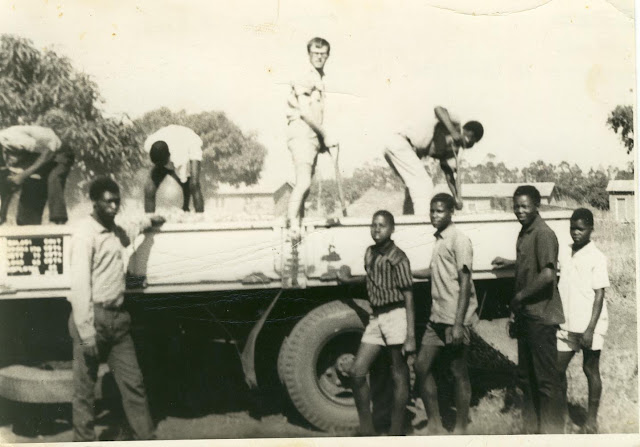
We also met a former student, Dr. Sosten Chiota from my first years of teaching at Mitundu Day Secondary School in 1968 to 1971. He and some alumni from the same era want to do something to rejuvenate the school which has fallen into a sad state. I will write that up when I get at the computer next time.

Subscribe to:
Post Comments (Atom)
No comments:
Post a Comment