Building Mitundu: Building Doug
Mitundu Day Secondary School
Anytime between 1969 and 1971
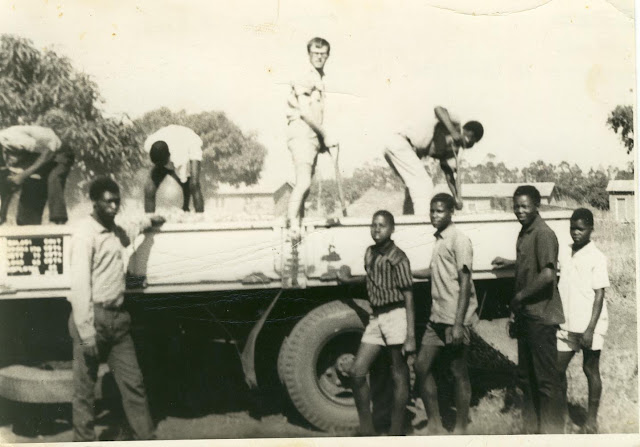
Many people help shape our lives. In my case it was a place, Mitundu Day Secondary School and the people I lived there with for 3 years. The picture shows a young man, not much older than his students and certainly not as worldly wise. He was learning more about life in 3 years at Mitundu than he did in 3 years at Carleton University getting his Bachelor degree. It was an experience that grounded an idealistic young man intent on contributing to nation building and who found his life course changed irrevocably as a result.
We were shovelling sand off the back of a flat bed truck, lent for the day to the the school by Mr Chapotera, a local business man. We were doing our part as self-help to build the school.
The secondary school site was nothing exotic to write travel books about. Dusty in the dry season, muddy in the rainy. Green and lush when the rain came, but brown and drab when the land dried up. A rough road ran by on its way to Mitundu trading centre and a side road ran over to Bunda College of Agriculture. Bunda was a growing college and was a great resource to have so near by. There was a busy market on Saturdays at Mitundu and it was a weekly ritual to pedal out there for supplies. During the rainy season, the road could become well nigh impassible. The area is part of Malawi's central plains with Bunda mountain dominating the local geography. These inselbergs, dot the highlands and offer majestic views. There was a forest reserve nearby that was a nice walk on hot days, but really there was nothing much to attract people to the area's otherwise flat fields and scrubby, plain, bush geography.
At first, we took over an existing primary school at the trading centre. It was a well constructed brick building with a high tile roof, but it necessitated a five mile drive twice a day over a terrible dirt road. The future campus was at the junction where the road to Bunda branched off, but nothing had been built when the first students were assigned to the school. The government was committed to putting schools in every district as part of the post-independence expansion of the educational system to make up for the century of colonial neglect. As we travelled back and forth 2 or 3 times a day from Bunda to Mitundu trading centre, they built the office block, the first 3 classrooms and the teachers' houses. We built much of the rest through self-help.
Housing for the students was always a problem. Since it was nominally a 'day' school the students were supposed to live within walking distance, but that was not the reality. They came from many distant places and at first were housed in old stores at the trading centre or paid room and board to local villagers with a spare room to offer. These were often decrepit, old storerooms and leaky sheds. The first 2 classes of Form One really had a difficult time of it. When the the new classrooms at the school site near Bunda were ready in January 1969 the first group had to move there and find the same kind of inadequate rooms among the local villages. The new group of Form Ones arrived to take up quarters in the Mitundu trading centre.
The students couldn't study in such adverse conditions so we organised study hall for 2 hours every night so they could access the classrooms, and study with proper lighting. We kept this tradition going even after we had hostels and more favourable conditions and there is no question this disciplined extra study was a contributing factor that led to so many of our students succeeding in their Junior Certificate exams.
Kennedy Msonda, the headmaster was dynamic, hard working and determined. He had spent a year in the USA and come back with a Yankee get-the-job-done mentality. He was going to build a school and was not about to let bureaucratic rules or lack of funds stand in the way. Most people were swept up in his energy and enthusiasm. In addition to managing the building of the school through government resources, he organised the self-help building of hostels for the girls and then the boys, added an extra classroom, put in a football field and a basketball court. When he could not get a truck from any ministry or government office, he would get Mr Chapotera, Mnjolo-Mkwinda or the Bunda principal to contribute. Mr Chapotera also helped us transport the school football and netball teams to other schools for competitions.
Kennedy recognised that his students came from other places and as such the government was not fulfilling its promise for the day schools to serve the needs of the students of the local community who thirsted for education. To serve the local demand for education, he set up night school which actually started at 4:00 in the afternoon as an outreach of the old Malawi Correspondence College. The classes were not limited in size and were huge compared to the day classes. The teachers would work with the day students from 7:30 a.m. to 1:30 p.m. when they got their lunch break and then return to teach the two classes of night school until 6:00 p.m. Working 2 shifts like this meant a lot of preparation and marking and long days. I was so tired that I would often fall asleep in the early evening as I was correcting assignments. To stay ahead, I learned to get up very early in the morning and get as much of my work done while I was still fresh. This has become a life-long habit, that carried me through my own studies for my masters degree.
Often Kennedy's drive to build the school made him push the students and staff really hard. I was single and nominally a volunteer who had signed up for just such an experience. On the other hand, the students found it hard to have to go to class in the morning and then be asked to shovel sand or carry loads of bricks to move the many projects forward. Teachers were paid to teach and did not always share his enthusiasm and belief in these extra-curricular self-help activities.
To keep some balance in their lives there would be events every weekend. He was passionate about football and the girls played netball. Some of the students were talented drummers and dancers and would perform traditional dances including the famous gule wamkulu. I had purchased some penny whistles that I lacked the talent to play, but again some of the boys could really make them swing. The dances were fun and the girls and the boys enjoyed trying to teach the Canadian how to dance and keep the most basic beat on the drum. Kennedy would borrow a slide projector from Bunda and show some of his slides from the USA and the few I had taken by that time.
One might think that it would have been tempting to escape to the more exotic mountainous or lake areas and I certainly did take the occasional holiday like that. But on the whole, I was so happy with my assignment and the social life around me that I spent most of my weekends for many months living and learning and exploring my rural environment. I was known as the hermit by the other Canadians I had come with to Malawi in July of 1968, because they saw so little of me. Once I had a bike, I would travel with Mr Ndjovuyalema all over the countryside and learn about the world of peasant farmers.
At Bunda College there were equal numbers of recent Malawian graduates and expatriates. I came to be good friends with several of the Malawi guys who enjoyed going to town with me for parties and other outings to the lake. Some like Alan Mtegha and Timothy Ngwira remained life long friends. Among the expatriates, I am still in touch with Mrs Betty Black, Frank Hannah and Margaret Gunn now Ngwira who is a naturalised Malawian. The presence of expatriates at Bunda meant I could usually get a lift to town, but because of my involvement with the school, I had little motive to leave.
Besides Kennedy, my other friends at Mitundu were extremely influential in shaping who I would become and teach me important lessons about life. Joe Kumbuyo was the school clerk. He was always friendly and informative. He had a slightly cynical eye that tempered my enthusiasm and naivety. Over the 3 years I spent there we became very close. Eventually when I was getting married, he acted as my family nkhoswe and helped me follow the Chewa customs and do things the proper way. He later married Hilda Namponya one of the beautiful girls I taught. Much later in 1996, he and Hilda hosted me for a month at Bunda where he had become an administrative officer. I got to know his family and their daughter Siyelini, in particular helped me in the research I was doing for my Master's degree.
Nellie Saka arrived in January 1969 with Betty Kaunda and Agatha Jalale as the new teachers to deal with the expanding student population. They were a wonderful addition and certainly added greatly to the social dynamic of our little community. Needless to say, the local bachelor population was glad to have three eligible and attractive women to talk with. The story of Nellie and I is another chapter to be written later. However, as we fell in love, I had less and less reason to leave the school and until the end of 1969 when she was unceremoniously transferred to Chichiri Secondary School, I was an extremely happy young man.
Mr Ndjovuyalema was a friend of Joe's, a peasant farmer and friend. He enjoyed interacting with the friendly mzungu and on weekends would take me for long bike rides through the countryside. He had an old bike held together by bits and pieces like many rural bikes. His heel served as a brake applied to the rear wheel. The roads only serve people with the means to take cars,trucks or buses. Out of sight, the countryside is a myriad spider-web of footpaths which serve the many people who rarely needed a road. These led to just about anywhere and places inaccessible to road traffic. We pedaled these paths to Mitundu, Mlale mission which had a couple of French-Canadian missionaries, to Malingunde dam where the expatriates sailed their boats on the weekends and even to Likuni Mission. Every little group of houses we would have to stop to greet someone he knew who was related to someone in another spider web of relationships. He introduced me to 2 of his wives and I learned about agriculture, dambo farming, and life in a small village. He and I met again in 1996 and he once again rode with me around the area and re-introduced me to its people.
Of course, the students were what the experience was all about. So many came from difficult circumstances and school was their chance to escape the life circumstances imposed by poverty. They were without exception hard-working, intelligent, wonderful humans, each with qualities that I admired. A number were older than me or at least the same age. Too many names have escaped my memory, but the faces, and their eagerness to learn remain indelibly etched. They struggled with English and turned it into a game to make it fun. “Sir, why do we say, 'I hope this rain keeps up.' when it is coming down?” The girls would often struggle hard to keep up and the arrival of the 3 women teachers made it much easier for them to see female role models who could inspire them to greater effort. The football and netball teams that Msonda nurtured were a source of great pride as we competed and won against students from fancier schools. The first group of students to write their Junior Certificate exams succeeded far beyond our expectations and Mitundu set a record for the new day schools of its kind with the number of form 2 graduates selected to continue on to form 3 in other schools around the country.
As I visit the country in my new role, I keep bumping into Mitundu alumni from that pioneer era. In January 2008, the group village headwoman for Bwanali, the village neighbouring Makupo came to visit after church and introduce herself as Alice Chingwede one of the students from the first group at Mitundu. She had become a prinary school teacher and taught for a number of years in the Mchinji area and now had returned to her home village and been elected as a group village headwoman. On a visit to Bunda College as part of this latest research with Christopher Stonebanks, we noticed a gentleman locking his office door to leave for lunch. He is Dr Stanley Khaila with his PhD in rural Sociology a lecturer at Bunda College and doing research with rural populations. He was also in one of the first groups. He was extremely welcoming and cordial and showed great interest in the rural research I am exploring now with Christopher Stonebanks. He also gave me the coordinates for Dr Sosten Chiota also from the second group to enter Mitundu. Sosten invited me to supper in Zomba when I passed through. It was a great evening of catching up and sharing. He is the one who provided me with the old picture of me on the truck. What a wealth of memories that photo unleashed. The students and staff worked extremely hard to build that school and became really close in the process.
Other people also were part of my post-adolscent growth and learning. The local chief, Mnjolo Mkwinda, also contributed to the building of the school with his transport and political support. The sound of the gule drums from his area on the bright moonlit winter nights was enchanting and mysterious. He was an industrious and prosperous man and he honoured me on my wedding day by attending with his youngest wife and representing me as part of his area. This greatly impressed and reassured Nellie's family that the boy their daughter was marrying was a credible person in the world he lived.
When I next saw the school in the mid 1970s it had undergone considerable expansion as part of an USAID programme to build infrastructure in eduation and health. The next time I saw the school was in 1996 and 20 years of neglect. After the short burst of investment in infrastructure, the international donors changed their philosophy with the election of Regan and Thatcher and all support for government infrastructure disappeared as support for free market private entreprise replaced planned and organised development plans. The government lacked the funds to maintain the infrastructure and the lovely edifices of the 1970s that represented such hope and possibility slowly decomposed with use, abuse and neglect.
Sosten and others from his generation have already begun meeting as alumni and were trying to track down their former teachers when I ran into Stanley at Bunda. Their goal is to try to rehabilitate the school and re-establish a bit of that sense of pride that we once had when we accomplished so much with so little. They have already begun re-establishing contact with many long lost classmates. Among the teacher alumni Kennedy, Joe and Mr Gausi are no longer with us. We can try to track down Betty Kaunda and Agatha Jalale in Malawi. Among the expatriate teachers, I know where Lorne MacLeod lives and will try to find David Scarborough and Carol Gabbert. David, a Peace Corps replaced Nellie when she left Mitundu and we taught together for a year and a half. Carol followed me as a CUSO and inherited my dog chiwewe. Lorne was there from 1974 to 1977 when CUSO withdrew from Malawi.
Reconnecting with everyone, sharing photos and memories would be a very useful thing at this stage in my life. Since retirement, I have become re-involved with my Malawi life and a 40 year old commitment to help bring change is burning anew. Re-examining the roots of this love of Malawi is very much part of a review of a life-time of involvement and trying to understand where I have been and what I have done. That experience has shaped me into what I am today. It may be a rather funny shape with age and baldness, but it's a good shape and Mitundu is certainly an important part of it.

Subscribe to:
Post Comments (Atom)
1 comment:
Dear Doug
I was interested in your blog on Mitundu School as I taught there for just under 2 years 1974-76. I am keen to contact Lorne MacLeod as I live on the island of Lismore off the west coast of Scotland, maybe where his forbears come from. Quite a few people left here to go to Cape Breton around 1820.
Dorothea Hay
Post a Comment